Better installation progress tracking starts with a clear scope of work
At an installation meeting, the team reports that half the instruments are installed. That sounds like half the work is done. But what does an installation include? Is the instrument simply in place, or are its connections, labelling and agreed checks also complete? And are the remaining installations the easiest or the most time-consuming?
To assess progress, the project needs a shared description of the work behind the numbers. This is where hookups, reusable details for typical installations, can play a role from engineering through to capturing lessons learned.
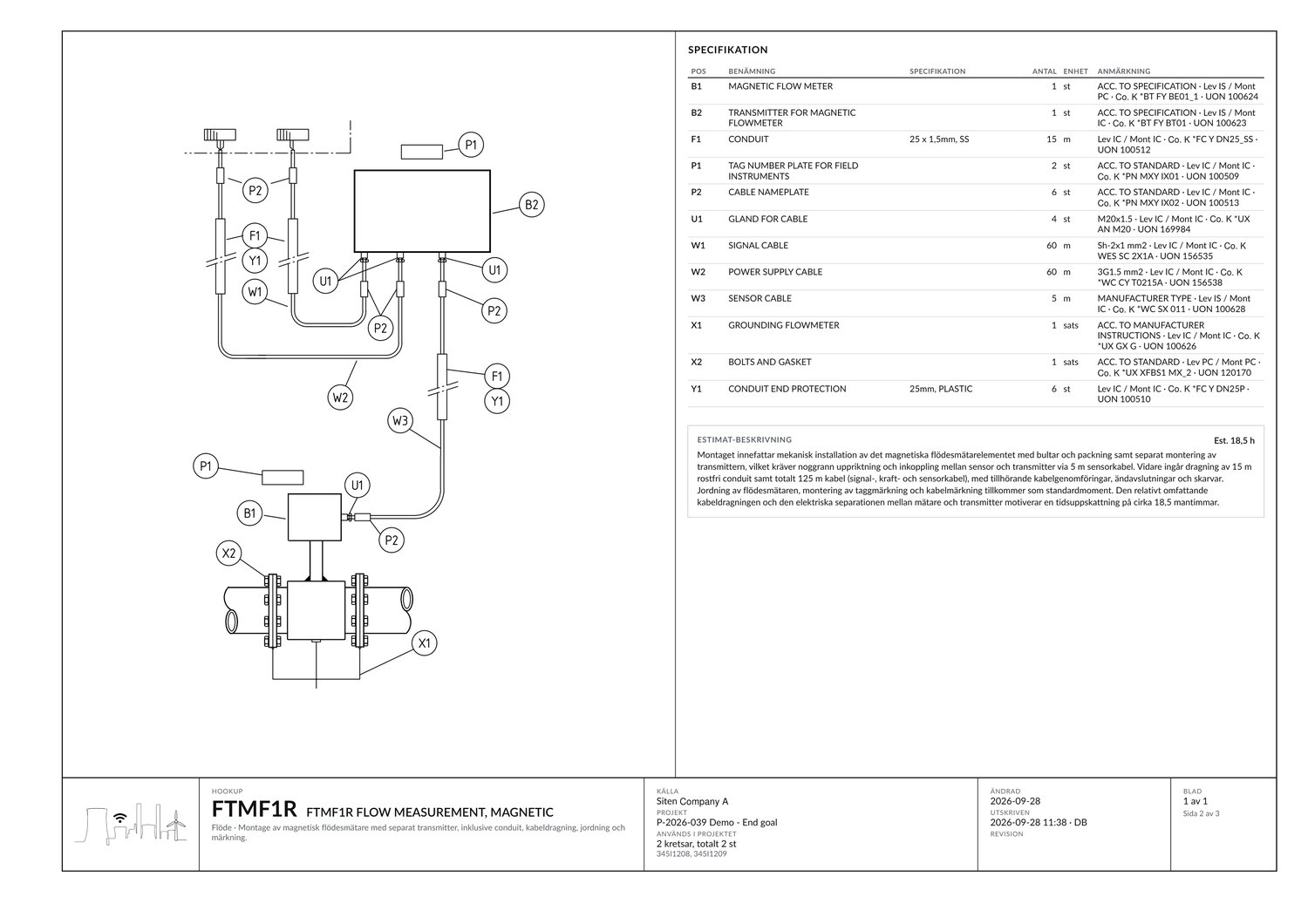
A hookup defines what the installation includes
In this article, a hookup means a set of details describing a defined installation type: how its parts fit together and which materials it includes. Linked to a time estimate with explicit assumptions, those details can help the project describe both what will be built and what the estimate covers.
Standardization also needs to accommodate technical differences. Swagelok describes how standardized instrument installations can simplify installation and maintenance, while factors including process fluid, temperature, pressure and location affect the configuration. The type therefore needs to suit the application. Source: Swagelok, Impulse Line Best Practices.
We recommend giving each installation type a clear ID, an identifiable revision and explicit scope boundaries. This makes it possible to establish whether two installations actually cover the same work when their results differ.
Hours spent and work completed are different measures
The US Department of Energy, DOE, describes Earned Value Management as a way to track work performed, cost and schedule against an approved plan. It notes that comparing actual and planned costs can be misleading without a measure of physical progress. Source: DOE, Earned Value Management.
Consider a simplified example: ten installations are estimated at two hours each and ten at eight hours each. The total is 100 estimated hours. When the ten simpler installations are complete, 50 percent of the units are finished, but they represent only 20 percent of the estimated workload. This example is illustrative and does not represent measured project results.
Both figures can be correct. They answer different questions. The count shows how many installations are complete; the weighting shows their share of the estimated effort. Actual hours spent need to be tracked separately. None of these measures alone determines whether the project will finish on time – sequencing and dependencies matter too.
Define completion before measuring progress
DOE's project management lexicon describes several progress measurement techniques, including units complete, milestones and the 0/100 method. Projects therefore have several possible methods to choose from. Source: DOE, Project Management Lexicon, Earned Value Technique.
For a short, recurring installation, a project might count the work as complete once an agreed check has been performed. For a larger installation, separate stages may be easier to track. Define the stages, their acceptance criteria and how they will be weighted. Also make the boundary with testing and commissioning explicit so that the same work is not counted twice.
Let the next project inherit the details and the lessons
A hookup library can reuse more than drawings and material lists. We also recommend retaining the assumptions behind the time estimate and the explanations for significant variances. Did the installation itself take longer, or was the result affected by waiting for materials, restricted access or a change in scope?
GAO's cost estimating guidance highlights documented assumptions, data collection and updating estimates with actual costs. This supports treating an estimate as a basis that needs to be reviewed and improved. Source: GAO, Cost Estimating and Assessment Guide.
For the next project, the task is to assess which assumptions still apply. Retain the previous project's details for comparison and document the new adaptation. This makes both reuse and change traceable.
Negotiated prices are useful when their context is retained
Negotiated item prices from previous projects can inform the next purchase. To support comparison, we recommend retaining the item and specification, unit, currency, date, purchase quantity and relevant delivery terms alongside the price. Also check whether freight or other costs were included before using an old price in a new estimate.
Track material prices and installation work separately. A price change can then be discussed as a purchasing matter, while a variance in working hours can be investigated in relation to scope and execution. This makes it easier to choose an appropriate action.
The value of a hookup in progress tracking lies in a connected record: which installation was intended, which assumptions applied, what was completed and what the project learned. When that record is documented, the next project has something concrete to build on.
Factual sources: DOE, GAO and Swagelok, linked in the relevant sections. Sources checked on 28 September 2026. Workflow recommendations are Bimdoc's analysis. The numerical example is illustrative.