Bimdoc steps out onto the production floor
Bimdoc has been built from the start to create structure in industrial information, grounded in recognised standards for plant structure, classification and information management. Technical objects, documents, permissions and relations should be handled in one context and stay with the business as it changes.
Our clearest focus so far has been plant information and industrial projects. With Bimdoc Production we take the next natural step, into daily production.
This is not an entirely new direction. On the contrary, the production module builds on the same foundation as the rest of the platform. A production station is also made up of technical objects, equipment, documents, instructions, people and activities. The difference is that the information is now used at a different pace, and closer to the work being done every day.
That makes Production both a natural development of Bimdoc and a new kind of challenge for us.
The same information model, new ways of working
In process industry a plant is often structured into blocks, departments and sub-departments. Discrete manufacturing instead uses terms such as factory, area, line, station and equipment.
On the surface these are two different worlds. Underneath the structure, many of the needs are the same:
- technical objects need to be classified and identified,
- documents and instructions must be tied to the right place,
- permissions and history need to follow the information,
- equipment has to be related to stations and work steps,
- changes must be traceable.
The Bimdoc information model is configurable and can therefore handle both structures. For manufacturing, Production starts from ISA-95, while a process plant can be structured according to SSG 5275.
This is not about forcing different operations into the same template. It is about using a common technical foundation and letting structure, classification and ways of working follow the business.
From plant structure to production flow
Once the structure is in place, it can be used in daily production work.
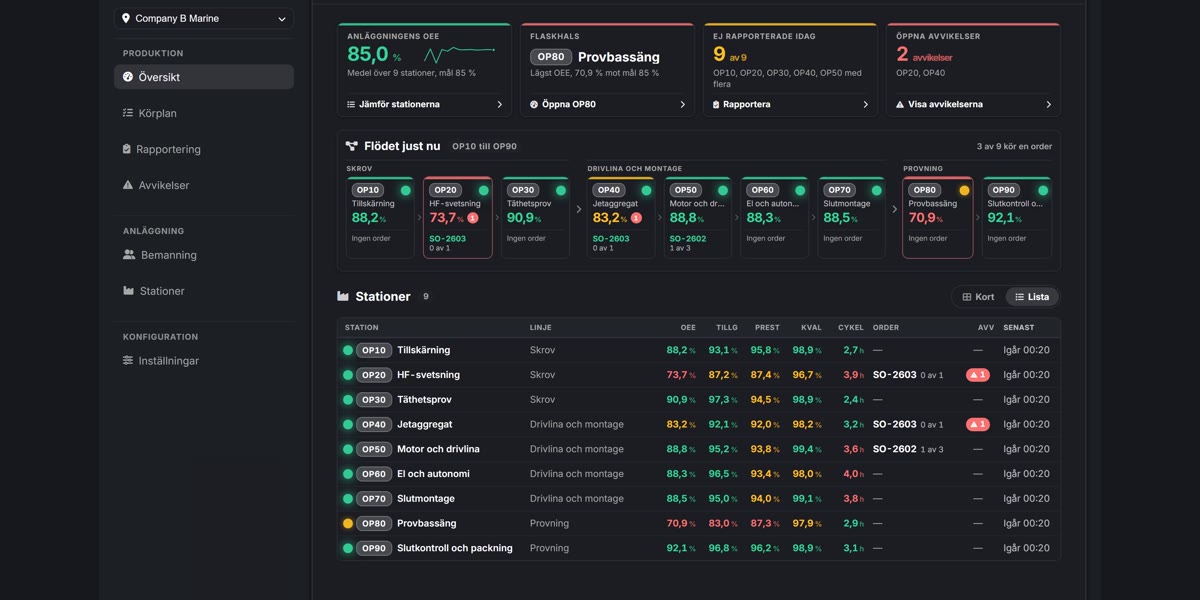
In Bimdoc Production, orders can be broken down into operations and planned against lines and stations. The operator sees what is running, what is next in line, and which instructions and checklists apply at the station. At the same time, production management can follow progress, staffing, deviations and key figures.
The module is being developed to support, among other things:
- production orders and operations,
- run plan and Gantt planning,
- station views with work steps and instructions,
- a stripped-down station mode for tablets,
- checklists and control plans,
- shift reporting and OEE,
- staffing per station and shift,
- deviations reported straight from the workstation.
These are functions that sit close to operational work. They therefore place different demands on a system than a traditional document or project tool does. The information has to be clear, quick to reach and shaped for the role using it. An operator should not have to navigate an administrative system to find the next work step or report a production stop.
Production follow-up does not have to begin with a large system project
Many manufacturing companies have parts of their production information spread across business systems, spreadsheets, planning boards, document folders and local solutions at the stations.
That does not mean everything has to be replaced by a single system.
Bimdoc Production is being developed as modular support for production control and follow-up. A company should be able to start with whatever is most pressing, for example station instructions, run planning or shift reporting, and build further when the business is ready.
For many operations, four reported values can be a good start: planned time, downtime, quantity produced and rejects. From those, the system can calculate availability, performance, quality, OEE and cycle time per station and shift.
This does not automatically replace every function in a full MES, and that is not the starting point either. Business systems, automation systems and specialised production systems should keep doing what they do best. The role of Bimdoc is to create structure, gather the operational context and make the information usable where the work is done.
A platform that can grow with more needs
The development of Bimdoc Production says something important about the platform as a whole.
Bimdoc is not locked to one type of plant, one project flow or one industry structure. When the information model is clear and dynamic enough, it can serve as the foundation for more business processes.
A technical object used in a project can later appear in a station view. The documentation can be used as a work instruction in production. A deviation can be tied to the same station and equipment it concerns. The information does not have to be built again for every module.
That opens Bimdoc to more kinds of operations, among them discrete manufacturing, component production and assembly. At the same time we keep the industrial foundation the platform is built on: structured information, clear relations and traceable change history.
The next step for Bimdoc
Stepping out onto the production floor means broadening Bimdoc, but it also means testing the platform against new demands and ways of working. It is a development we look forward to.
Bimdoc Production is taking shape as part of the same platform as Core, View and Projects. The products have different jobs, but they use a common information model for objects, documents, classification and permissions.
We believe industry gets more out of specialised functions when the information between them holds together.
Bimdoc Production is the next step in that development.

CEO, Bimdoc AB